
Successful deboning line operator efficiency for manual poultry processing

Use Case Measurable Impact Quick Overview:

The Problem

40 stations. Zero manual counting. Real-time performance for poultry deboning line efficiency. 

Manual broiler deboning is one of the most labour-intensive and performance-variable operations in poultry processing. On a line with 40+ stations, individual operator output – measured in caps per minute – determines the throughput rate of the entire line. Yet across most operations, this metric for determing deboning line efficiency is effectively invisible. 

Supervisors observe spot samples at best. There is no systematic way to know which stations are fast, which are slow, when an operator steps away, or how cycle time trends across a full shift. The result: lost yield, inconsistent throughput, and performance conversations based on subjective observation rather than objective data for your poultry manufacturing operation.

Without visionAI  With visionAI 
  • Supervisors estimate performance.
  • Spot checks cover 2–3 stations at a time.
  • Underperforming stations are identified reactively – often hours later.
  • Coaching conversations lack objective evidence. Line balance cannot be quantified or corrected in real time.  
  • Every station monitored simultaneously, every minute of every shift. Supervisors receive real-time alerts when a station falls below threshold.
  • Coaching conversations are backed by data. Line balance can be measured, tracked, and optimised continuously. 
  • Operating too slow is an efficiency problem, operating too fast is a quality & yield problem.
  • Consistent efficiency at the right pace is key – visionAI measures this for each station – every second of every day with visual evidence.  

The Solution

The business case 

Even marginal improvements in cycle time consistency across a 40-station deboning line deliver measurable yield and throughput gains. The gains from closing the gap between average and top-quartile operators compound across every shift. 

Throughput Gains 

Identify and close the gap between average and top-quartile operators. Line output improvements of 5–15% achievable within 90 days of active monitoring. 

Targeted Coaching 

Objective data replaces subjective observation in performance conversations. Supervisors know which station, which shift, which operator – with visual evidence. 

Root Cause Visibility 

Separate operator-driven delays from supply-driven idle time. Make the right intervention – don’t penalise an operator for a supply chain issue, and don’t miss a real performance gap. 


Using overhead IP cameras positioned above the deboning line, visionAI’s AI agent – trained specifically for poultry processing tasks – continuously monitors each station and automatically detects:

Caps per minute – per station, continuously  The flagship metric. Captures the speed and rhythm of each operator throughout the shift, enabling performance benchmarking, line balance analysis, and targeted coaching. 
Operator presence and absence  Real-time detection of whether each station is staffed. Enables immediate supervisor alerts for unmanned stations and historical reporting on coverage gaps across the shift. 
Station-level throughput trends  Identifies fast, slow, and idle periods per station – distinguishing operator-driven slowdowns from supply chain constraints (product not arriving at station). 
Supply waiting time  Detects when operators are idle due to insufficient product supply arriving at their station – separating operator performance from upstream supply issues. 
Line-level roll-up  Aggregate caps per hour and per minute for the full deboning line – enabling shift-level benchmarking, cross-shift comparison, and trend analysis over time. 
Phase 2: Quality verification  Same cameras can verify skin removal and tenderloin presence per cycle – bridging efficiency intelligence with quality verification in a single camera view. 

Purpose-trained AI models – not generic computer vision – recognise poultry-specific operator actions, cap counts, and station-level activity with high accuracy. The AI agent learns from production data, improving precision over the first weeks of deployment. Using vision based AI technology can accelerate your poultry monitoring operations. 

The Result

What poultry processing operations teams see 

Station-Level Report  Cycle Time Report  Line Roll-Up Report 
Caps per hour, per station 

Continuous real-time view of individual operator throughput. Identifies high performers and stations falling below line average during the shift. 

Caps per minute, per station 

Granular cycle time data at station level, showing intra-shift rhythm and pace fluctuations. The core performance benchmarking tool for supervisors. 

Aggregate line performance 

Station-level data rolled into a single line view – total caps per hour and per minute, shift-level benchmarking, and cross-shift trend analysis. 

Outputs for effective poultry debone line monitoring system

Delivery 

Real-time via the visionAI web dashboard. Mobile alerts via WhatsApp / Teams when station falls below threshold. Shift summary report – exportable PDF and data feed. 

Integration 

Data outputs integrate into existing MES, ERP, or BI platforms. Designed to enrich current operational systems – not replace them. 


Vision AI monitoring can transform your deboning line efficiency. Your existing cameras could be making a better ROI for your operations. Learn how visionAI can ncrease your poultry deboning production with minimal interruptions.
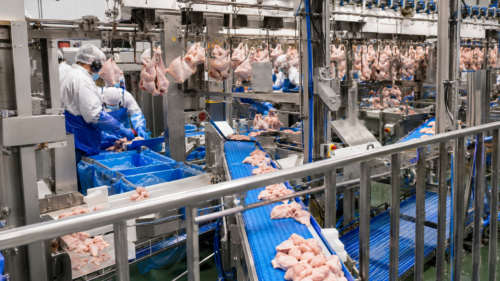
deboning line efficiency

Ready to improve your factory production efficiency?

Related posts