

In manufacturing, counting is fundamental. Units produced. Crates packed. Cycles completed. Downtime events logged. For most of the last 30 years, the sensor has been the tool of choice for this job – and for good reason. Reliable, purpose-built, and deeply integrated into the control systems running most production floors, sensors remain the default counting tool across the industry.
But the debate around computer vision vs sensors manufacturing is no longer theoretical. As AI-enabled cameras mature and existing CCTV infrastructure becomes more capable, manufacturers are asking a harder question: are sensors still the right tool, or is there a richer data source available from hardware already installed on the floor?
This post gives an honest comparison. Not a sales pitch for either approach – a genuine assessment of what each does well, where each falls short, and how to think about the choice in the context of your own production environment.
Computer vision vs sensors manufacturing: what are we actually comparing?
Before getting into the detail, it’s worth being precise about what we mean by each technology in a manufacturing context.
- Sensors – in the context of production counting – refers to photoelectric, inductive, laser, and proximity sensors deployed at specific points on a line to detect the presence, absence, or passage of objects. They generate a binary or analogue signal that feeds directly into PLCs, SCADA systems, or MES platforms.
- Computer vision – in a manufacturing context – refers to AI-enabled cameras (including existing CCTV and IP cameras) that interpret a visual scene rather than measuring a single variable. Rather than detecting that something passed a point, computer vision analyses what passed, what condition it was in, and what else was happening in the frame at the same moment.
The distinction is important because these technologies are solving slightly different problems – and understanding the difference is what makes the comparison useful.
The case for sensors
Sensors earn their place on the production floor. They are purpose-built, highly reliable, and in the right context, extremely accurate.
Where sensors excel:
- High-speed single-variable counting. Inductive, photoelectric, and laser sensors can detect passing objects at very high cycle rates, making them the right tool for fast-moving lines where millisecond precision matters and the only question is “did it pass?”
- Single-variable accuracy. When you need to measure one thing very precisely – a gate trigger, a fill level, a presence/absence signal – sensors do it with minimal complexity and very low latency.
- Harsh environment tolerance. Industrial-grade sensors are built for heat, moisture, and vibration in ways that cameras have historically been more vulnerable to. In foundry, chemical, or heavy fabrication environments, sensors remain the more resilient option.
- Direct PLC and SCADA integration. Sensors speak natively to the control systems already running most plants. Integration is mature, well-understood, and doesn’t require a new software layer.
Where sensors fall short:
- One sensor, one variable. A photoelectric sensor tells you a crate passed. It cannot tell you what was in it, whether it was complete, or what condition the product was in. Every additional data point requires an additional sensor – with its own installation, cabling, and integration cost.
- Installation requires line intervention. Fitting sensors typically means stopping the line, mounting hardware at specific positions, and running cabling. In high-throughput environments, that downtime has a real cost that gets underestimated at the planning stage.
- Scaling gets expensive fast. A single sensor measuring one variable is affordable. A sensor network covering multiple lines, multiple variables, and multiple locations compounds quickly – in hardware cost, installation time, and integration complexity.
- No visual context. When something goes wrong, a sensor tells you that it went wrong. It cannot show you why. For root cause analysis, that absence of visual evidence is a significant limitation.
- Cybersecurity exposure. Each connected sensor is an endpoint on your OT network. As industrial systems become more networked, managing that attack surface is a growing concern for IT and security teams.
The case for camera-based production monitoring
AI-enabled cameras – including existing CCTV and IP cameras running computer vision software – approach counting differently. Rather than measuring a single signal, they interpret a scene.
Where camera-based production monitoring excels:
- Counting with context. Consider a bread crate moving along a conveyor at the end of a packaging line. A sensor confirms the crate passed. A camera confirms the crate passed – and can simultaneously determine how many loaves are in the crate, whether any are missing, whether the packaging matches the expected SKU, and whether there are visible quality defects. All from a single frame, on a single camera.
- Multiple variables from one source. A well-positioned camera replaces what would otherwise require several sensors, plus manual visual inspection, plus a quality check. One data source generating multiple data streams simultaneously.
- Non-invasive deployment. In many facilities, cameras are already installed. Activating AI on existing infrastructure requires no line stoppage, no hardware mounting at the line, and no production disruption. This is one of the most underappreciated advantages of camera-based monitoring – the asset is already there.
- Visual evidence trail. Every count comes with a visual record. When a discrepancy is flagged, you can review exactly what the camera saw. That evidential layer is something no sensor can offer – and for quality disputes, compliance audits, or root cause investigations, it changes the nature of the analysis entirely.
- Scalable across the facility. Once the platform is running, extending coverage to additional lines or areas is largely a software configuration exercise, not a new hardware project. The marginal cost of monitoring an additional line drops significantly once the core infrastructure is in place.
Where camera-based monitoring has limitations:
- Line-of-sight dependency. Cameras measure what they can see. If a team member walks across the frame, if steam or dust obscures the lens, or if products are stacked in a way that blocks the view, measurement accuracy is affected. Good system design – camera positioning, alert logic, and exception handling – mitigates this, but it requires upfront planning.
- Lighting sensitivity. Changes in ambient lighting, shadows, or reflective surfaces can affect image quality and model performance. Industrial deployments need to account for lighting conditions from the outset, not retrofit for them later.
- AI model quality matters. A camera is only as good as the AI interpreting its feed. Poorly trained models, or models not calibrated to a specific production environment, will undercount, misclassify, or generate noise. Implementation quality is not optional – it is the determining factor in whether the system performs.
- Compute requirements. Real-time video inference requires more processing than a binary sensor signal. Cloud or edge compute infrastructure is a prerequisite, and that infrastructure cost needs to be factored into any comparison with sensor-based alternatives.
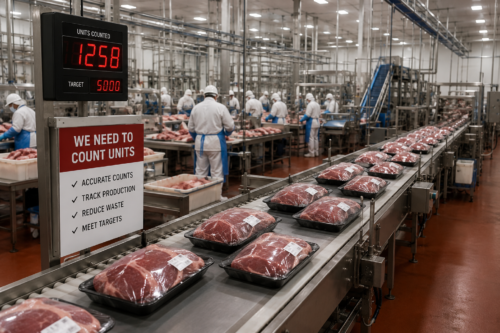
Computer vision vs sensors in manufacturing: side-by-side
|
Capability |
Sensors |
Cameras (AI-enabled) |
|
High-speed single-variable counting |
✅ Excellent |
✅ Good |
|
Multi-variable counting from one source |
❌ No |
✅ Yes |
|
Quality assessment at point of count |
❌ No |
✅ Yes |
|
Visual evidence of count events |
❌ No |
✅ Yes |
|
Non-invasive installation |
❌ Requires line stop |
✅ Uses existing cameras |
|
Scalability cost |
⚠️ Increases with each variable |
✅ Largely software-based |
|
Accuracy in obstructed conditions |
✅ Unaffected |
⚠️ Line-of-sight required |
|
Harsh environment tolerance |
✅ Very high |
⚠️ Depends on camera grade |
|
Root cause investigation support |
❌ No visual record |
✅ Full visual evidence trail |
|
Cybersecurity surface area |
⚠️ Each sensor = endpoint |
⚠️ Managed at platform level |
You may also find this read worthwhile: AI quality control: Why your existing cameras are the best ROI in 2026 and beyond
Frequently asked questions
Can cameras replace sensors in manufacturing?
In many counting and monitoring applications, yes – AI-enabled cameras can replace multiple sensors while simultaneously providing richer data. However, sensors remain the better choice for ultra-high-speed binary detection, direct PLC integration, and environments where cameras cannot be reliably positioned or maintained. The most effective approach in complex facilities is often a combination: sensors where precision and speed are paramount, cameras where context and multi-variable data add more value.
What is the difference between sensors and cameras for production counting?
Sensors detect a single variable at a specific point – whether an object passed, a level was reached, a gate was triggered. AI-enabled cameras interpret a visual scene, enabling simultaneous measurement of multiple variables from a single source: count, condition, completeness, and quality in a single frame. The core difference is breadth of data: sensors give you a signal, cameras give you evidence.
How accurate is computer vision for counting in manufacturing?
Modern AI computer vision systems achieve high accuracy in well-configured deployments – typically above 95% for counting applications in standard production environments. Accuracy is most affected by line-of-sight obstruction, lighting consistency, and the quality of the AI model’s training data. Systems properly calibrated to a specific production environment and product range perform significantly better than generic off-the-shelf models.
Is computer vision suitable for high-speed production lines?
Computer vision is well-suited to most production line speeds, including high-throughput environments. For applications requiring detection at extremely high cycle rates – where millisecond response times are needed to trigger control system actions – dedicated sensors remain the more reliable choice. For monitoring, counting, and quality inspection at line speed, modern edge-compute vision systems perform effectively.
What infrastructure is needed for AI camera-based monitoring?
Most facilities already have the camera infrastructure required. The primary additional requirement is edge or cloud compute to run AI inference on the video feed, along with the software platform to process, store, and surface the resulting data. In many deployments, existing CCTV cameras can be repurposed without replacement.
The bottom line
Sensors and cameras are not competitors – they are different tools designed for different jobs, and the most capable manufacturing operations will use both.
Sensors remain the right choice where ultra-high-speed binary detection is required, where direct control system integration is critical, or where the operating environment makes camera deployment impractical.
But for manufacturers who want to understand what is being produced – not just that something passed a point – camera-based production monitoring offers a fundamentally richer data source. The shift from “did a crate pass?” to “what was in that crate, was it complete, and did it meet quality standard?” is not a minor upgrade. It’s a different class of operational intelligence.
As AI improves and existing camera infrastructure becomes more capable, the question is no longer whether cameras can count. The question is: what else can they tell you while they do?
See what your existing cameras already know about your production lines. Book a demo →