

Lessons from the field and what we heard at the 2026 POPCORN Innovation Summit
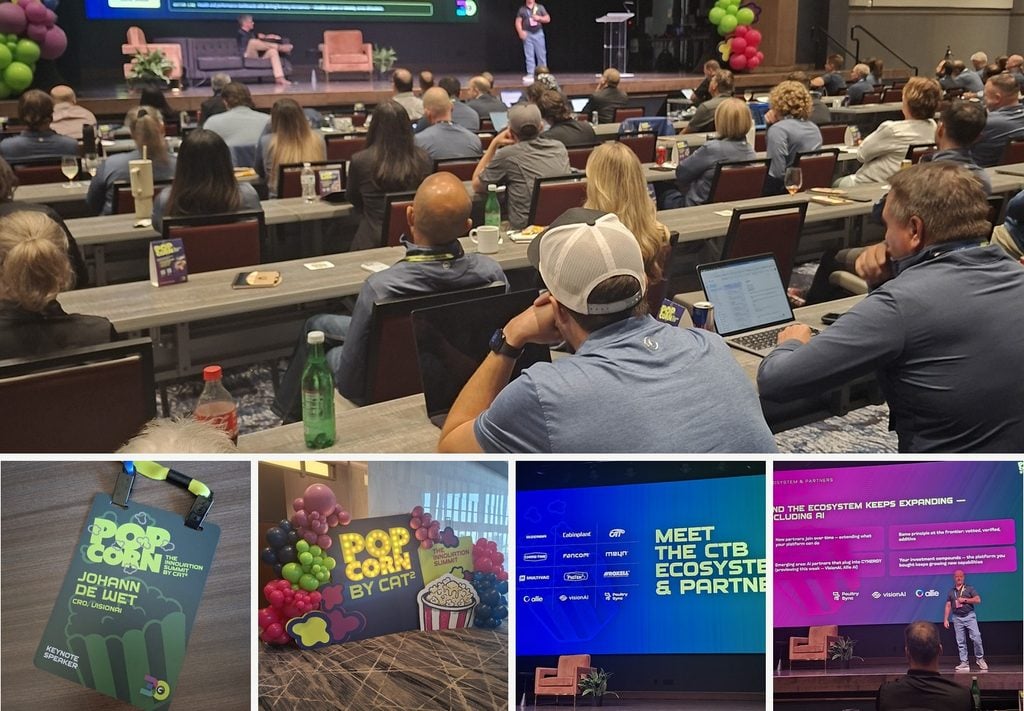
Last month, the visionAI team spent a week in the field – customer visits across Arkansas, Tennessee, and Georgia, followed by four days at CAT Squared’s POPCORN Innovation Summit in Hot Springs, Arkansas.
Roughly 100 protein industry operators, technology partners, and processors gathered to talk through the technology, opportunities, and challenges facing the sector.
visionAI was there as both sponsor and presenter, with Johann de Wet delivering an insightful session titled, “The Missing Intelligence Layer: How Your Cameras Can Answer the ‘Why’ Your ERP and MES Never Could,” – expanding on the important role of visual intelligence for protein manufacturing, and joined the “Operational Intelligence” panel alongside Dr. Amit Morey (Auburn University), author Dion Engelbrecht, and Alex Sandoval (CEO, Ally Systems).
A common problem the room already agreed on
Protein manufacturers aren’t short on data. Machines, sensors, and PLCs throw off weight, temperature, production counts, and downtime constantly. But as one phrase from the room put it, plants are “drowning in data, starving for insight.” That data is siloed machine by machine, and it’s limited to what a sensor can physically measure. It tells you what a machine did and when it did it. It doesn’t tell you why.
This challenge put visionAI front of the room: CCTV cameras that are already installed – for other reasons, on other jobs – prove out a line that stuck from the summit: what cameras can see, sensors can’t measure. Sensors only ever watch equipment. Everything else typically falls back to manual capture, which is subjective, retrospective, and inconsistent – or as the week’s other memorable phrase put it, it means “operating by looking in the rearview mirror.”
The sharpest example of that gap: nobody’s been systematically watching whether the people running the equipment are following the process they’re supposed to follow. SOP compliance has been left to manual capture because it’s been the only option – one visible case of a broader pattern, where anything a sensor structurally can’t reach either goes unmeasured or falls back to a manual process with the same flaws.
We framed this as visual intelligence: connecting what’s currently siloed line by line, and layering in a missing intelligence layer wherever sensors simply can’t reach. AI copilots have an obvious role to play in plant operations, but a copilot is only as good as the data feeding it: sensors alone hand it plenty of numbers with no understanding of why any of it happened.
Connected visual intelligence is the layer that sits between the two: sensors capture what’s happening, visionAI supplies the why, and that’s what gives copilot automation something worth acting on.
What the plant visits confirmed
The customer site visits gave the session’s argument a physical backdrop. Most lines we walked had only one or two measurement points total – a weight, a count, a downtime trigger – with everything else running blind. This was most visible in further processing, where operational activity is largely unmeasured today.
Compliance came up as a concrete, provable win rather than an abstract benefit: parts of USDA compliance can be seen and automated by camera instead of manually prepared for ahead of an audit, and our customers have reported real time savings from having audit-ready reports on hand rather than compiling them under pressure.
We also heard a consistent, honest hesitation: operators are wary of adding more sensors. Sensors disrupt production, cost money, need maintenance, and each does exactly one job. Repeatedly, at sites where a processor wanted a sensor but held off installing one, a camera was already there – already able to see and measure that gap. Non-intrusive, unprompted, was the word customers kept using: it doesn’t touch the line, it doesn’t affect production.
Vision means more than inspection
Protein manufacturing already uses vision-based systems – but almost always for product inspection at a fixed point on the line, in service of yield. That’s a well-served use case, and not what we’re competing with. The question we kept posing back to operators was simple: you already have the cameras – why aren’t you using them for the rest of the plant? Beyond yield, that same visual intelligence extends into throughput, downtime, food safety compliance, and giveaway.
Three themes kept surfacing as concrete use cases:
- Visual OEE. The clearest, most immediate need in the room – using existing cameras to enrich OEE automation on further-processing lines like chicken strips, noodles, sausage, MSP, and ACM.
- Operator efficiency. Measuring productive vs. non-productive time in labor-intensive processes – hanging, deboning, filleting, packing – and understanding how labor supply affects productivity on a given line.
- Sanitation. A natural extension rather than a separate build: the same cameras already watching production also cover the area during sanitation, confirming SOPs are being met.
One more sharply-defined need came up around QSR (quick-service restaurant) delivery: proving the correct piece count was delivered in a bag – 9 pieces, 18 pieces, whatever the order calls for. Today, when a customer disputes the count, the processor has no way to prove or disprove it. A visual record closes that gap.
Why it matters
ERP and MES tell you what happened. visionAI tells you why. That’s the positioning that resonated with a room already speaking in these terms before we said a word – turning “downtime occurred” into “downtime occurred because of X.”
That’s the real takeaway from the week: this wasn’t a hard sell. It matched language the industry already uses about itself, and the plant visits reproduced the exact pattern the session predicted. We’re grateful to CAT Squared and everyone at POPCORN Summit for the conversation, and we’re looking forward to carrying it into the rest of the industry.